Is Parasailing in St. Thomas Safe? Honest Answer and Who Shouldn't Fly
Is parasailing in St. Thomas safe? Statistically, yes: across roughly 170 million US parasail rides between 1982 and 2012, about 1,800 injuries were recorded, an injury rate near 1 in 94,000 rides and a fatality rate near 1 in 500,000. It isn't risk-free, and it genuinely isn't for everyone. Pregnancy, certain weight and age limits, and a few physical conditions rule some travelers out before they book. Below we cover the real numbers, who actually regulates a parasail boat here (it isn't who most people assume), the real risks and how good crews manage them, the full restriction table, and how to pick a safe operator at Sapphire Beach or Havensight.
Quick answer
Parasailing in St. Thomas is statistically very safe: about 1,800 injuries across roughly 170 million US parasail rides between 1982 and 2012, an injury rate near 1 in 94,000 and a fatality rate near 1 in 500,000. It isn't risk-free, and it genuinely isn't for everyone.
Key takeaways
- The safety-record headline: roughly 60 injuries a year nationwide against millions of rides, per the NTSB's 2014 special report
- The US Coast Guard licenses the boat and captain here, not the parasail gear itself, and the USVI has no territorial parasail law of its own
- The two exclusions that rule out the most travelers: pregnancy and a combined weight outside 150-500 lbs (68-227 kg)
- Vet an operator by asking about their wind-hold policy and how full they'll pack the boat in marginal weather
- The full restriction table below covers weight, age, pregnancy, and more, condition by condition
Is Parasailing Safe, or Is St. Thomas Safe?
This guide answers one question: is the parasail flight itself safe. Whether St. Thomas as a destination is safe to visit, crime, unrest, general travel conditions, is a different question this page won't guess at. For that, the US State Department's four-level travel advisory system, or your own government's equivalent, is the source that actually tracks current conditions, not a tour-focused guide.
Everything below covers the flight, the boat, and the crew.
What Thirty Years of US Ride Data Show
The clearest number available comes from the National Transportation Safety Board's 2014 special report on parasailing accidents (SIR-14/02), covering the US industry broadly. Between 1982 and 2012, roughly 170 million parasail rides were flown nationwide with about 1,800 recorded injuries, an average near 60 a year. That works out to an injury rate near 1 in 94,000 rides and a fatality rate near 1 in 500,000, an order of risk closer to a routine car trip than most people expect walking up to the harness.
The NTSB's report found towline failure the leading cause of the serious accidents it reviewed, not weather or operator error in isolation. That finding pushed the industry toward the voluntary ASTM F2993 standard covering gear inspection and towline maintenance, adopted unevenly but increasingly treated as a baseline by reputable operators. No incident detail or operator name belongs in a number like this; the point of an aggregate stat is context, not a specific story.
Who Actually Regulates a Parasail Boat in the USVI
The US Coast Guard inspects the vessel and licenses the captain under federal maritime rules, the same framework that covers any commercial boat operating out of Sapphire Beach or Havensight (USCG Marine Safety Information Bulletin 002-19). What the Coast Guard does not regulate is the parasail canopy, harness, or the flight operation itself, and that's a real gap, not an oversight on our part.
There's no USVI territorial parasail statute filling that gap. Florida's White-Miskell Act, a state law passed after a string of accidents there, only applies in Florida; it has no reach in St. Thomas. The voluntary ASTM F2993 standard exists, and responsible operators follow it, but nothing requires them to. That combination, federal vessel oversight plus no territory-specific flight-gear law, means the operator you choose is your single biggest safety lever here, more than in a place with a dedicated statute on the books.
Where the Real Risk Lives
Five real risk mechanisms, each paired with the mitigation a competent crew actually applies:
| Situation | What a good operator does | Warning sign |
|---|---|---|
| Towline wear or a rushed pre-flight check | Inspects the line and harness before every flight, retires worn gear on a schedule | No visible inspection, or gear that looks frayed or mismatched |
| Marginal wind that's borderline for a safe flight | Calls a hold or cancels outright rather than pushing ahead | Crew saying they'll try it anyway in visibly gusty conditions |
| A boat packed past its comfortable capacity | Sticks to a set guest count and doesn't squeeze in extra flyers | Pressure to add one more passenger during boarding |
| Reef or shallow-water hazards near the flight zone | Keeps flights over open water off Sapphire Beach with clear depth | Flying uncomfortably close to shore or moored boats |
| Sun and dehydration across a 75-minute deck day | Offers water and shade while you wait your turn | No water offered across the full trip |
The one water contact on the trip, an optional dip at the very end of the flight, is brief and in open Caribbean water rather than a swim, so water quality isn't a meaningful factor here the way it would be on a snorkeling trip.
How to Choose a Safe Operator in St. Thomas
Ask directly before you pay: what's the wind-hold policy, and will they refund or reschedule rather than push a marginal flight? How full do they pack the boat, and will the crew turn away extra flyers if a slot is oversold? What does the pre-flight safety briefing actually cover?
A cheap listing isn't automatically a cut corner, our cost guide covers what a lower price actually trades away, but the questions above are the same at every price point.
Green flags: an unhurried, real briefing rather than a signature grabbed in passing, gear that looks maintained and matched, a crew that answers wind questions plainly instead of deflecting, and a stated policy for rebooking weather holds rather than a vague 'we'll see.'
Red flags, named specifically: a rushed waiver with no real review, a crew saying they'll squeeze one more flyer in during marginal weather, no wind-hold policy posted or explained, and unattended bags left at the marina with no reminder to keep valuables close. That last one is a property risk, not the physical-safety concern this section is mostly about, but a crowded marina dock is still worth keeping your bag zipped and nearby for.
A quick pre-booking checklist that turns the vetting advice above into six yes-or-no answers.
- Wind-hold or weather-cancellation policy stated clearly
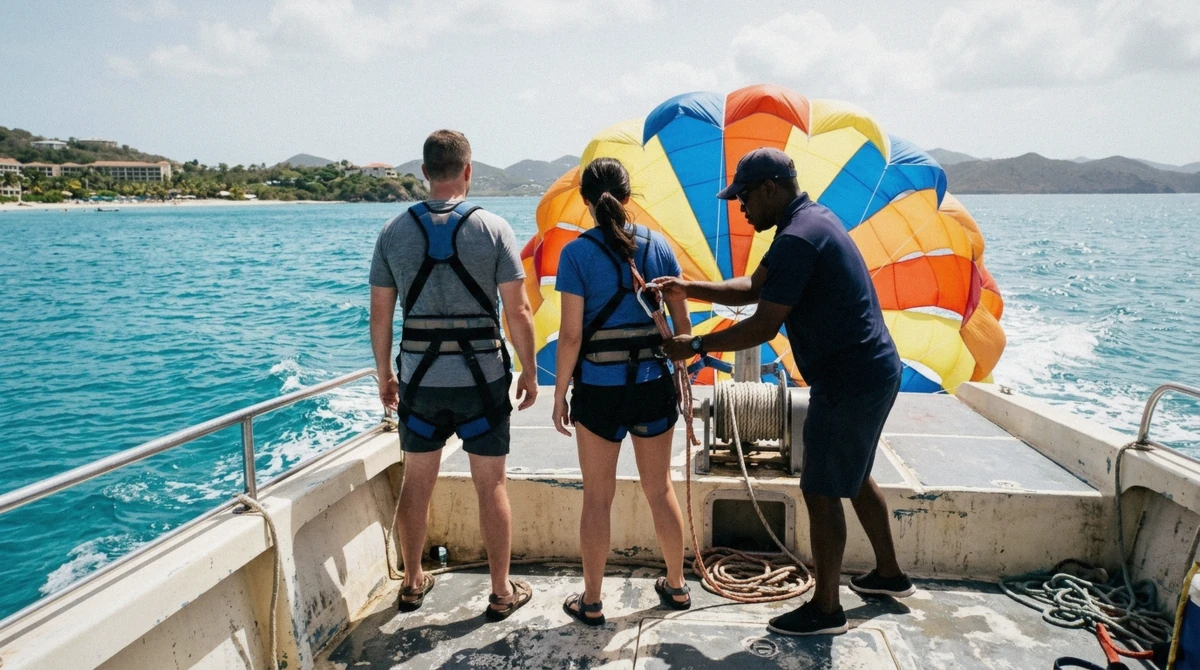
- USCG-approved life vest and full-body harness confirmed
- Free cancellation window confirmed
- Crew runs a real briefing, not a rushed waiver signature
- Boat guest count matches what's advertised
- Morning slot booked for the more reliable flying window
The Sapphire Beach flight publishes its rating openly, 4.8 across 1,306 reviews, which is the kind of volume worth checking against whatever else you're comparing.
Who Shouldn't Do It: Restrictions at a Glance
Every restriction below reflects a real, sourceable rule on this site's own tour, not an invented one.
| Restriction | Typical rule on St. Thomas tours | Why it exists | Ask before booking if... |
|---|---|---|---|
| Pregnancy | Excluded; not permitted on any flight | The harness pull and any hard water contact on the dip are not safe during pregnancy | You're pregnant at any stage |
| Minimum age | 6 years old | Below that the harness and briefing aren't sized or paced for a younger flyer | You're traveling with a child under 6 |
| Weight (individual) | No separate individual cap beyond the combined limits below | Solo flyers are weighed against the combined range, not an individual one | You're flying solo and want to confirm where you land in the range |
| Weight (combined, tandem) | Minimum about 150-200 lbs (68-91 kg), maximum 450-500 lbs (204-227 kg), set daily by the captain based on wind | Too light and the canopy won't fly cleanly; too heavy and the tow line and canopy are rated past their safe limit | Your combined weight with a flying partner is near either end of that range |
| Heart condition or high blood pressure | No formal exclusion, but a real consideration given the harness pull and quick ascent | The takeoff and any turbulence put a brief load on the cardiovascular system | You have a diagnosed heart condition or uncontrolled blood pressure |
| Back problems or recent surgery | Generally excluded or requires operator sign-off | The harness sits across the hips and shoulders and the takeoff has a moment of real pull | You've had recent spinal or abdominal surgery, or a chronic back condition |
| Mobility limitations | Boarding and the harness fit need reasonable mobility; ask the operator directly | Getting into the harness and onto the platform takes some independent movement | You use a mobility aid or have limited lower-body strength |
| Swimming ability | Not required; a USCG-approved life vest is worn throughout | The vest, not swimming ability, is what keeps you afloat if the dip option is used | You're a non-swimmer and want to skip the water dip entirely, ask the crew to keep you dry |
| Intoxication | Not permitted | Following the harness and safety briefing quickly matters, and alcohol impairs that | You or a companion have been drinking before a booked slot |
If the Weather or the Gear Says No: Scenarios, Honestly
A wind hold before you board
What happens: the captain checks conditions and calls a hold before anyone flies. What the crew does: waits it out on the dock or reschedules the slot. What you do: follow the operator's stated wind-hold policy and expect a rebook or refund rather than a refusal outright.
A mid-trip recall
What happens: wind shifts once a flyer is already up. What the crew does: reels the flyer in early rather than letting the flight run its full time. What you do: trust the crew's read on conditions and don't fight the harness if the flight ends a minute or two short.
A towline or gear inspection flags an issue
What happens: a pre-flight check turns up wear on the line or harness. What the crew does: grounds that specific piece of gear and swaps in a checked replacement rather than flying it anyway. What you do: treat the delay as the system working, not a reason to push the crew to skip the check.
Weather cancels the whole day
What happens: a storm or sustained high wind rules out flying entirely. What the crew does: rebooks or refunds according to their stated policy. What you do: check that policy before you book, and if you're timing a flight around a cruise stop, see the cruise-day guide for how morning slots hedge against a weather-tight afternoon.
Across all four scenarios, one lever matters most and it's entirely within your control: disclosing a real medical condition honestly and choosing an operator with a stated wind-hold policy do more for your outcome than anything that happens once you're on the boat.
Safer Alternatives If You're Excluded
There's no second on-the-water product on this site to steer excluded travelers toward, so the honest alternative is simpler: Sapphire Beach itself is worth the visit even without the harness, and anyone excluded by weight, pregnancy, or a back condition can still watch the flights from the sand or the marina deck. If you clear every line in the table and are now weighing the price against the airtime instead, whether the flight is worth it is its own question with its own honest answer.
Frequently Asked Questions
Has anyone died parasailing in St. Thomas?
No independently published record ties a visitor death specifically to St. Thomas parasail operations. The nationwide aggregate stat above, about 1,800 injuries across 170 million rides, is the honest context available.
Can I fly while pregnant?
No. Pregnancy is excluded on every flight, at any stage, because of the harness pull and any hard water contact on the optional dip.
Is there a weight limit for parasailing in St. Thomas?
Yes, a combined limit rather than an individual one: roughly 150-200 lbs (68-91 kg) minimum and 450-500 lbs (204-227 kg) maximum, adjusted daily by the captain based on wind.
Is it safe for someone with a heart condition or high blood pressure?
No formal exclusion exists, but the harness pull and quick ascent are a real consideration. Talk to your doctor and mention the flight's specifics before booking.
Is it safe for non-swimmers?
Yes. A USCG-approved life vest is worn throughout the flight, and swimming ability isn't required; you can also ask the crew to skip the optional water dip.
What happens if the weather turns bad mid-flight?
The crew reels a flyer in early or holds the boat at the dock, depending on when the shift happens. Refund or reschedule terms follow the operator's stated weather policy.
Do I need special travel insurance for parasailing?
Standard travel insurance often excludes named adventure activities like parasailing, so check whether your policy needs an add-on rider for injury and evacuation coverage, separate from the operator's own weather refund policy.
Parasailing in St. Thomas is safe by the numbers that exist: a federally inspected boat, a licensed captain, and an injury rate near 1 in 94,000 rides. It genuinely isn't right for everyone; pregnancy, certain weight ranges, and a few physical conditions rule some travelers out honestly. The lever most within your control is the operator you pick: ask about the wind-hold policy before you ask about the price, and confirm the Sapphire Beach flight fits what you're looking for.